
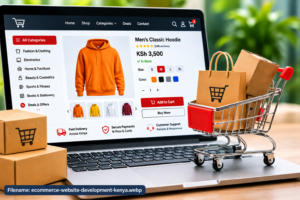
E-commerce website development Kenya is a key search topic for business owners looking to create professional online stores, accept digital payments and reach more customers. At Replypoints ICT Solutions, we provide e-commerce website development services in Kenya, helping retailers, wholesalers and growing businesses build secure, mobile-friendly online shopping platforms with M-Pesa integration, inventory management and search engine optimisation (SEO).
Whether you operate a fashion boutique in Nairobi, an electronics shop in Thika, a cosmetics business in Mombasa or a wholesale company serving customers across Africa, having a professional online store can help you organise sales and reach customers beyond your physical location.
However, successful online selling requires more than an attractive website. Customers need clear product information, convenient checkout, reliable payment options and transparent delivery policies. Business owners also need efficient systems for processing orders, tracking stock and monitoring performance.
This guide explains the benefits of e-commerce website development, essential online store features, development costs, payment integration, marketing strategies and how to choose a suitable website development company.
What Is E-commerce Website Development?
E-commerce website development is the process of building an online platform that allows businesses to sell products or services through the internet.
Unlike a standard business website, an e-commerce website supports activities such as product browsing, shopping carts, checkout, online payments and order management.
For example, a clothing retailer can display dresses, shoes and accessories on its website. Customers can select available sizes, choose colours, review prices and place orders without visiting the physical shop.
Depending on the business requirements, an e-commerce platform can also include customer accounts, inventory tracking, delivery management and sales reporting.
The purpose is to create a convenient shopping experience while giving business owners greater control over their operations.
Why E-commerce Website Development Kenya Matters for Businesses
Many Kenyan businesses begin selling through WhatsApp, Facebook, Instagram and physical retail shops.
These channels are useful for attracting customers, but managing large numbers of enquiries and orders manually can become difficult as a business grows.
A dedicated e-commerce website provides a structured platform for displaying products, receiving orders and managing online transactions.
1. Reach Customers Across Kenya and International Markets
A physical shop mainly serves customers who can visit its location. An online store allows people in other towns and counties to discover available products.
For example, a retailer in Thika can market products to customers in Nairobi, Nakuru, Kisumu, Eldoret and Mombasa.
Businesses with suitable payment and delivery arrangements can also sell to customers outside Kenya.
2. Accept Customer Orders Around the Clock
An e-commerce website allows customers to browse products and submit orders even when your physical shop is closed.
Customers can select products, review prices, provide delivery details and complete available checkout steps at their convenience.
Orders can then be processed according to the business’s operating schedule.
3. Build Customer Trust and Credibility
Customers want reliable information before making online purchases.
A professional online store should display accurate product descriptions, clear prices, business contact details, delivery information and return policies.
Genuine customer reviews and transparent business information can help customers make informed purchasing decisions.
4. Reduce Manual Administrative Work
Managing orders through separate messages, spreadsheets and notebooks can lead to missed enquiries and inaccurate records.
An e-commerce system can centralise customer orders, payment statuses, product information and inventory records.
This helps business owners organise operations and reduce repetitive administrative tasks.
5. Support Business Growth
An online store can support product promotions, repeat purchases, customer communication and digital advertising.
Businesses can also analyse sales information to identify popular products, monitor stock movement and improve purchasing decisions.
Actual sales growth still depends on customer demand, product quality, competitive pricing and effective marketing.
Essential Features of a Professional E-commerce Website
A successful online store should combine attractive design with practical features that support both customers and business owners.
Mobile-Friendly Website Design
Your online store should work smoothly on smartphones, tablets and desktop computers.
Customers should be able to browse categories, view product photographs, select items and complete checkout without unnecessary difficulty.
A responsive website provides a consistent shopping experience across different devices.
Product Catalogue and Category Management
An organised product catalogue helps customers find what they need.
For example, an electronics retailer may organise products into smartphones, laptops, computer accessories and home appliances.
Each product page should include accurate photographs, descriptions, specifications, prices and availability information.
Shopping Cart and Secure Checkout
A shopping cart allows customers to select multiple products before completing a purchase.
The checkout process should clearly display product quantities, total costs, delivery charges and available payment methods.
Simple checkout forms and transparent pricing can make purchasing more convenient.
M-Pesa Payment Integration
M-Pesa integration is an important consideration for businesses serving Kenyan customers.
An e-commerce website can integrate supported mobile money payment solutions to allow customers to pay during checkout.
Depending on the integration, the system may also support payment confirmation and automated order status updates.
Merchant approval, integration requirements and transaction charges depend on the selected provider.
International Payment Gateway Integration
Businesses targeting international customers may require debit card, credit card or other supported payment methods.
The appropriate payment gateway depends on supported countries, transaction currencies, business eligibility and applicable security requirements.
Inventory Management System
Inventory management helps businesses track product quantities and stock movement.
An integrated system may automatically update stock levels when orders are confirmed.
Advanced features can include low-stock alerts, product variations, warehouse management and inventory reporting.
Customer Accounts and Order Tracking
Customer accounts can allow returning buyers to view previous purchases, manage delivery information and monitor order statuses.
Order tracking features can also help businesses communicate purchase progress from confirmation to fulfilment.
Website Security and Data Protection
An e-commerce website handles customer information and interacts with payment services.
Important security practices include HTTPS, secure authentication, appropriate access permissions, regular backups and ongoing maintenance.
Businesses should also comply with applicable data protection and consumer protection requirements.
How Much Does E-commerce Website Development Cost in Kenya?
The cost of developing an online store depends on the number of products, design requirements, payment integrations and additional functionality.
A small retailer may need a straightforward online store with product listings, a shopping cart and payment processing.
A larger business may require inventory synchronisation, wholesale pricing, customer management, delivery integrations and advanced reporting.
Website Design and Customisation
A standard online store generally requires less development work than a platform with extensive custom features.
The design should reflect your business identity while keeping navigation and checkout straightforward.
Number of Products
The size of the product catalogue affects data preparation, product organisation and website configuration.
Large catalogues may require bulk imports, advanced search filters and product variation management.
Payment Integration Requirements
Integrating M-Pesa, card payments or other payment services can involve configuration, testing and provider approval.
Inventory and Software Integration
Businesses that need their online stores connected to existing inventory, accounting or customer management systems may require additional development.
Delivery and Shipping Features
Delivery zones, shipping calculations, courier integrations and order tracking can influence the overall project scope.
Maintenance and Technical Support
Online stores require ongoing security updates, backups, performance monitoring and technical maintenance.
Before selecting a development package, request a quotation that clearly identifies the included features, responsibilities and recurring costs.
Replypoints ICT Solutions provides customised e-commerce website development quotations based on your business requirements and project scope.
E-commerce Website Development for Different Industries
Different businesses require different online selling features.
Fashion and Clothing Stores
Fashion retailers may need size variations, colour options, product galleries, promotional discounts and seasonal collections.
These features help customers explore products and select suitable options.
Electronics and Gadget Shops
Electronics businesses benefit from detailed product specifications, warranty information, product comparisons and accurate stock availability.
Customers should be able to understand product differences before making purchases.
Beauty and Cosmetics Businesses
Cosmetics retailers can organise products by category, brand and intended use.
Accurate product information, clear photographs and genuine customer reviews support informed purchasing decisions.
Furniture and Home Décor Stores
Furniture businesses may need detailed product dimensions, multiple photographs, delivery options and quotation requests for customised items.
Supermarkets and General Retailers
Businesses selling many product categories may benefit from advanced product search, inventory management, promotional pricing and delivery scheduling.
Wholesale and Distribution Companies
Wholesale platforms may require bulk ordering, minimum order quantities, customer-specific pricing and account-based purchasing.
These features support more complex business-to-business transactions.
E-commerce Website vs WhatsApp and Social Media Selling
WhatsApp, Facebook, Instagram and TikTok can help businesses showcase products and communicate with customers.
However, a dedicated online store offers greater control over product organisation, checkout and order management.
| Feature | Social Media Selling | E-commerce Website |
|---|---|---|
| Product catalogue | Platform-dependent | Customisable categories |
| Customer enquiries | Often message-based | Product pages and checkout |
| Order management | Often manual | Can be automated |
| Payment options | Vary by platform | Integrated checkout |
| Inventory tracking | Often separate | Can be integrated |
| Branding | Platform-dependent | Greater design control |
| Search visibility | Platform-dependent | Dedicated SEO opportunities |
For many businesses, combining social media marketing with a professional online store provides a practical approach.
Social media helps customers discover products, while the website provides a central platform for browsing and placing orders.
How E-commerce SEO Helps Businesses Attract More Customers
Building an online store does not automatically generate sales.
Businesses need strategies that help potential customers discover their products and make informed purchasing decisions.
Search engine optimisation is one important part of that process.
Keyword Research for Online Stores
Keyword research identifies phrases customers use when searching for products.
For example, a furniture retailer may target relevant searches for office desks, ergonomic chairs and home furniture in Kenya.
Keywords should reflect actual products, customer needs and search intent.
Product Page Optimisation
Product pages should contain descriptive titles, original information, accurate specifications and clear photographs.
Useful descriptions help customers understand products and provide relevant information to search engines.
Category Page Optimisation
Category pages organise related products and help visitors navigate an online store.
Important categories should have descriptive titles and useful introductory information.
Image Optimisation
Product photographs should be clear, appropriately sized and supported by descriptive alternative text where relevant.
Optimised images can also improve website loading performance.
Internal Linking
Internal links connect related products, categories and informational articles.
For example, a guide about choosing office furniture can link to relevant desks and chairs available in the store.
Technical E-commerce SEO
Technical optimisation includes website crawlability, mobile usability, canonical URLs, structured data and duplicate URL management.
These practices help search engines discover and understand important store pages.
Digital Marketing Strategies for E-commerce Businesses
Search engine optimisation can support organic visibility, while other marketing channels can help businesses reach additional customers.
Google Ads
Google Ads allows businesses to advertise relevant products to people searching online.
Campaigns should be evaluated using purchases, conversion rates, advertising costs and other meaningful business indicators.
Facebook and Instagram Marketing
Social media platforms can help businesses showcase products, share offers and engage with customers.
Advertisements and posts can direct interested visitors to relevant product pages.
TikTok Marketing
Short product demonstrations, tutorials and informative videos can help customers understand product features.
Content should reflect your products and target audience.
Email Marketing
With appropriate customer consent, businesses can use email marketing to share product updates, promotions and useful information.
Conversion Rate Optimisation
Conversion optimisation focuses on making it easier for website visitors to complete desired actions.
Improvements may include clearer product information, transparent delivery charges, faster loading pages and simpler checkout forms.
International E-commerce Website Development for Global Businesses
Businesses targeting international markets need to consider payment processing, shipping arrangements and customer expectations.
Important requirements may include:
- Multiple currency display.
- Supported international payment gateways.
- Country-specific shipping information.
- Appropriate tax and customs information.
- Multilingual content where necessary.
- International customer support.
- Relevant privacy and consumer protection measures.
International SEO may also require content tailored to the search behaviour and needs of customers in different countries.
For example, a business targeting the United Kingdom, United States or Canada should research those markets rather than simply duplicating identical pages for each country.
Replypoints ICT Solutions provides website development and digital solutions for businesses serving Kenyan and international markets.
How to Choose an E-commerce Website Development Company in Kenya
Choosing the right development partner is important because your online store affects customer experience and business operations.
Before hiring a developer, consider these questions:
- Does the company understand your business model and target customers?
- Can it develop the features your business needs?
- Does it understand relevant payment integrations?
- Will your website be mobile-friendly and easy to manage?
- Can the platform support future growth?
- What security and maintenance arrangements are available?
- Does the company provide SEO and digital marketing support?
- Will you receive clear project deliverables and support terms?
A suitable development company should explain the available options and recommend functionality that matches your business requirements.
Why Choose Replypoints ICT Solutions for E-commerce Website Development Kenya?
At Replypoints ICT Solutions, we understand that businesses need digital platforms that support practical operations, not simply attractive websites.
Our services combine website development, custom software, search engine optimisation, digital marketing and business automation.
Professional Online Store Development
We develop e-commerce websites designed around business requirements, product presentation and customer convenience.
Payment Integration Solutions
We support projects requiring M-Pesa and suitable international payment integrations, subject to provider requirements.
Inventory and Order Management
We develop or integrate systems that help businesses organise products, monitor stock and manage customer orders.
Search Engine Optimisation
Our SEO services focus on website structure, relevant content, technical accessibility and opportunities for organic search visibility.
Digital Marketing Support
We provide digital marketing services to help businesses promote their products and reach relevant audiences.
Custom Software Development
Businesses with specialised requirements can discuss custom systems for inventory, customer management, reporting and automation.
Technical Support and Maintenance
We provide website maintenance and technical support services according to the agreed project scope.
Our approach begins with understanding your business, identifying the required features and recommending suitable digital solutions.
Frequently Asked Questions About E-commerce Website Development in Kenya
How much does an e-commerce website cost in Kenya?
The cost depends on design requirements, product catalogue size, payment integrations and custom functionality. A project-specific quotation provides the most accurate estimate.
Can an e-commerce website accept M-Pesa payments?
Yes. Supported M-Pesa payment solutions can be integrated into an online store, subject to merchant approval and technical requirements.
Can I manage products and orders myself?
Yes. An appropriately configured e-commerce system can allow authorised users to add products, update prices, manage stock and process orders.
Can an e-commerce website sell products internationally?
Yes. International selling is possible when the business has suitable payment processing, shipping arrangements and compliance measures.
How long does it take to develop an e-commerce website?
Development time depends on project complexity, available content, integrations, testing and approval requirements.
Does an e-commerce website need SEO?
SEO helps search engines discover and understand product pages and categories. It can improve opportunities for organic visibility, although rankings are not guaranteed.
Can Replypoints redesign an existing online store?
Replypoints provides website development services and can assess an existing online store to determine suitable redesign or improvement options.
Conclusion: Grow Your Business with E-commerce Website Development Kenya
E-commerce website development Kenya is an important search topic for businesses looking to build professional online stores, accept digital payments and improve order management.
A successful online store should combine professional design, secure payment options, organised product catalogues, inventory management and search engine optimisation.
However, long-term success also requires effective marketing, reliable customer service and continuous improvement.
At Replypoints ICT Solutions, we help businesses plan and develop professional e-commerce websites and supporting digital solutions for Kenyan and international markets.
Ready to launch your online store or improve your existing e-commerce website?
Contact Replypoints ICT Solutions to discuss your requirements and request a customised quotation.
Contact Replypoints ICT Solutions
Website: https://replypoints.co.ke
Email: info@replypoints.co.ke
Phone/WhatsApp: +254 710 632 400
Office: Alisa Plaza, 8th Floor, Thika Town, Kenya.
Follow Replypoints ICT Solutions
Stay connected for e-commerce development tips, SEO insights, digital marketing strategies, website design updates and business technology solutions.
Social media: Facebook | Instagram | LinkedIn | TikTok | YouTube
Visit https://replypoints.co.ke to find our official social media channels.
Replypoints ICT Solutions — Building Digital Solutions That Help Businesses Grow.